Showing posts with label musicians. Show all posts

Friday, August 22, 2014

Signature Spotlight


Thinking about purchasing a Powell flute but afraid that it might not meet your budget?  We understand that "one size does not fit all" when it comes to flute prices -- and options!  Also, hand craftsmanship is not limited to Powell Custom models, either, because all of our flutes are handmade!  So, if you are looking for handmade flute with an economical price tag and the options to accommodate your preferences as a player, the Signature is an excellent choice.

The Powell Signature flute offers hand craftsmanship and the "Powell Sound" at an affordable cost.  The Signature's body and headjoint are both sterling silver, and the Signature headjoint was created specifically to accompany the Signature flute.  The headjoint makers here in the shop who cut the styles offered on our Custom and Conservatory flutes also cut Signature headjoints.  The Signature's drawn tone holes are formed using Powell's patented Zinki technology, and the pinned mechanism is completely built by hand.  Signature options include B foot or C foot, inline or offset G, C# trill, split-E (on offset G models), and a 14k riser.

In addition to the Signature flute, there is also a Signature piccolo!  The Signature piccolo has been described as a responsive, professional instrument with evenness throughout the scale and a consistent, sweet sound.  As one of two Powell piccolo models, Signature piccolos are crafted by the same flute makers who build the Custom piccolos.  The Signature piccolo body is made from grenadilla wood, and the mechanism is sterling silver.  Signature piccolos also have the option of a split-E and the choice of a Classic or Wave style headjoint.

For more information on Signature flutes and piccolos, click here to visit the Signature flute page on the Powell website and here for the Signature piccolo page.

Friday, April 25, 2014

Powell's 70th Anniversary and the NFA

Powell Custom Wooden Flutes debuted at the 1997 NFA
As we were preparing for the this year's NFA Convention in Chicago, we happened to discover a few materials in our archive from a previous year when the Convention was held in the same location.  The 1997 NFA Convention took place in Chicago and marked two significant milestones for Verne Q. Powell Flutes -- an anniversary and a product debut.  Founded in 1927, Powell celebrated its 70th anniversary in 1997.  In celebration of its anniversary, Powell also introduced a new wooden flute.  We uncovered one of the original 1997 brochures for the NFA Convention, which described the new flute as follows:
THE POWELL WOODEN FLUTE:
A TRADITIONAL FLUTE IN A MODERN WORLD

Powell's new wooden flute hearkens back to a time when all flutes were made of wood, and also looks forward to a new century where all things are possible.

The abandonment of wooden flutes came about as musical tastes changed, and as metal-working techniques became more sophisticated.  Precious metal flutes had the further advantage of never cracking, and being relatively light and comfortable.

Our new wooden flute retains the warm sonority of traditional wooden instruments.  However, the surprise for today's flutist goes beyond the instrument's beautiful keywork and amazing comfort.  This Powell flute, made of grenadilla or red ironwood, provides wonderfully quick articulation.  Durability and response have been enhanced by unified mechanical construction, and by crafting separate grenadilla tone holes that are then attached to the wooden body.  This is an instrument that is equally at home playing baroque chamber works as it is performing modern music with a large orchestra.
Looking at the brochure, we can see that there are some differences between the wooden flutes from 1997 and the current ones.  In 1997, the flutes were made with tone holes that were attached to the body.  Today, the tones holes are carved from the body (see our previous post on wooden flute tone holes by clicking here).  Also, in 1997 there was an option of grenadilla or ironwood bodies and either an offset or "half offset" G.  Today's wooden Custom Powell flutes are all made from grenadilla and have an offset G -- although we did experiment and produce an inline G, which you can see by clicking here to go to the Facebook album.

We are looking forward to the 2014 NFA Convention and will have a few new things at the booth once again...  Stay tuned by following announcements on our Facebook page and website.

Front of brochure
Back of brochure
Description of wooden flute
Inside of brochure, unfolded


Wednesday, April 9, 2014

The One and Only White Gold Flute

By Steven Wasser
President, Verne Q. Powell Flutes, Inc.

In 1949, Verne Powell wrote the following: “I consider this flute the finest thing I’ve ever created.  The gold is much harder than yellow gold or platinum and has a 'ring' and brilliance I’ve never heard in my flute.”

Those were strong words from a master craftsman about Powell flute #900.  His words were addressed to Fritz Baker, principal flutist with the Denver Symphony at the time, and Powell was describing the performance characteristics of a flute made entirely of white gold.  In another letter to Baker in January 1950, Powell wrote, “There never has been a finer flute made – but as far as we are concerned, there will never be another like it.”

What happened?  Apparently, Powell had always wondered what a white gold flute would sound like.  In his view, the hardness of white gold “should make a splendid instrument.”  To satisfy his curiosity, Powell produced a flute with 14k white gold body and keys on speculation.  Flute #900 was the result.

The problem was that the same qualities which produce an especially rich sound from white gold make it very difficult to fabricate.  In that same letter to Baker, Powell explained, “The metal is incredibly tough to work, and we had plenty of headaches, including darn near ruining every tool in the shop.”  How tough?  At Powell, we use 10k white gold mechanism tubing as a substitute for sterling silver in certain applications where we want to make sure the flute keys stay in adjustment.  When we ream the white gold, the steel reamer smokes on its way through, even with plenty of lubricant added.

Back in 1950, Baker went on to buy Verne Powell’s one-and-only white gold flute and record with it.  Today, Fritz Baker is 94 years old and retired from his illustrious career.

In one of Powell’s letters to Baker, he speculated, “We might some day make a flute with a white gold tube and all silver mechanism, as it was the [hardness of the white gold] mechanism that presented the real problem.”  Today, Mr. Powell’s speculation is reality.  Powell offers 14k white gold flutes with a sterling silver, 10k yellow gold, or 14k rose gold mechanism.  Here’s a photo of one we just finished with a white gold body and 14k rose gold keys.


The pricing for the 14k white gold flutes is the same as for 14k rose gold flutes, and they are available for trial.    

Friday, January 24, 2014

The Handmade Conservatory Flutes of Yesterday and Today

A 2013 Conservatory - inline with split-E
Looking back through our archives, we found the 2002 Powell Handmade Conservatory brochure, which was the first brochure for that particular model line.  Twelve years later, the Handmade Conservatory flutes are some of Powell's most popular models.  So, how have they changed?  Looking at the original brochure helps answer that question...

The Handmade Conservatory flutes of 2002 had at least one characteristic from their predecessor, the 2100 -- the "Posi-Stop" tail design.  The brochure describes this feature as follows:
Posi-Stop design
In order to maximize the response of the flute, none of the key tails rest on the flute tube.  Instead, their movement is halted by nearby invisible Posi-Stops, which look like small spring posts set on the ribs of the flute.
Also, the early Handmade Conservatory flutes, just like today's models, offered the choice of a Powell Custom headjoint.  The difference in 2002 was that the headjoint styles available were the Boston and the Philharmonic.  The headjoint descriptions from the brochure are below:
The Boston style headjoint combines its own, graceful embouchure plate with modern undercutting techniques.  It is easily controlled, and produces an open, clear tone with exceptional projection.

The Philharmonic headjoint is readily identified by its broader embouchure plate.  Articulation is crisp and clean, and this style is capable of broad dynamic and timbral ranges.  A player can create a deep, rich tone with extraordinary carrying power and focus.
Today, the Philharmonic cut is one of three Custom headjoint styles (Philharmonic, Soloist, and Venti), all of which are available with the Conservatory models.

Finally, when comparing "spec charts" from the 2002 and 2014 brochures, we can see differences in G key and split-E options in particular.  In 2002, the Handmade Conservatory flutes (just like today) were offered with either an inline or offset G.  However, in 2002, Handmade Conservatory flutes that had a split-E were "half offset."  Today's Handmade Conservatory flutes come with a split-E option for both inline and offset models.  The split-E inline option was introduced on the Handmade Conservatory flutes in 2013.  Also, both the 2002 and current Handmade Conservatory flutes have French (open) cups.  The 2002 models came with the option of American cups, which were French cups with Plug-Os.  Between 2002 and 2014, Handmade Conservatory flutes have kept their material choices, being offered in either sterling silver or Aurumite 9k.  For more on the today's Handmade Conservatory flutes, visit https://powellflutes.com/flutes/handmade-conservatory.

2002 Spec Chart
2014 Spec Chart
Page from the 2002 brochure highlighting choices.
Page from 2002 highlighting body material and headjoint styles.


Thursday, August 29, 2013

The Distance Between...


One of the questions that our Repair Technician, Rachel Baker, gets asked quite frequently is about changing the pitch on a flute.  Many people have flutes pitched at A-440 and want to change them to A-442.  So, the question posed to her by many customers is, "Can we just cut the headjoint and shorten it up a bit to change my flute over to A-442?"

Unfortunately, it's the positioning of the tone holes on the
body and the length of the body that determine the scale and pitch of the flute.  In fact, it is the placement of the tone holes in relation to each other that truly make the scale of the instrument.  So, cutting the headjoint would really not affect anything.  If you think about a piccolo, the length of the body is much shorter than that of a flute -- and the tone holes are much smaller.  However, the tone holes are placed in a relative distance between each other to allow for the instrument to have the appropriate scale and pitch.

Powell instruments currently use the Powell scale, which is a modified Cooper scale.  The development of this scale was discussed in a previous post here at http://www.flutebuilder.com/2013/02/flute-scales.html.  The Powell Scale is available on all Powell flutes, whether they are pitched at A-440, 442, or 444.  The scale is also available on all flutes, whether they have drawn or soldered tone holes. 


Friday, August 16, 2013

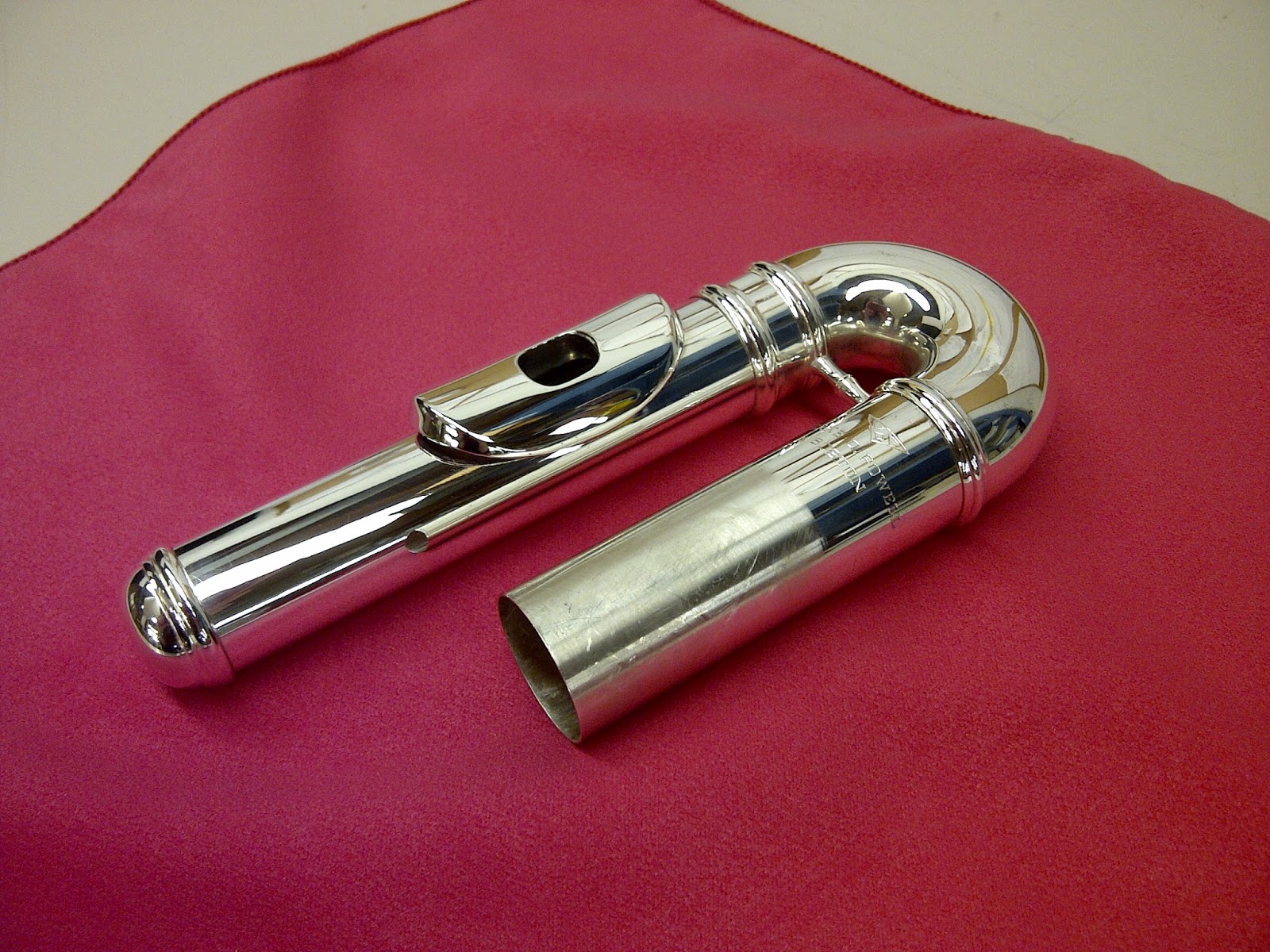
Curved Alto Headjoint

Looking back on our visit to the NFA Convnetion this year, we realized that many people didn't know we make a curved alto headjoint.  We make both a curved and a straight headjoint for both of our Powell Sonaré alto models: the AF-60 and the AF-70.  The AF-60 has a silver plated nickel-silver body, and the AF-70 has a sterling silver body.  Both of our headjoints (straight and curved) are sterling silver and fit on either model alto flute.


So, what are some of the differences with the curved headjoint?  Well, since the headjoint is curved, it shortens the length of the flute, making it easier to reach.  Some people think the curved headjoint has a different sound from the straight one, but the curved headjoint may sound different mostly because it is closer to you -- so it changes the way you hear yourself.  Obviously, the air flows through a curved headjoint differently than it does with the straight one because the air flow follows the shape of the tube.  With the curved headjoint, the air flows around the inner curve.  However, there is really not much difference in the amount of air you would use for the two headjoints.  Choosing a curved or straight headjoint is simply a matter of the player's preference.  Some people find that the curved headjoint is more comfortable because there is less of a stretch for their arms overall with the shortened length of the flute.

The Powell Sonaré alto flute models are available with a straight headjoint, curved headjoint, or both.  We do make double cases so that you can easily fit both headjoints in the case with the flute.  If you purchase a curved headjoint only, the flute will come (automatically) with the double case.  (Powell does not offer a single case for the curved headjoint option).  As with all Powell Sonaré models, the alto is available through authorized Powell Sonaré dealers.  For more information, visit the Powell Sonaré section of the Powell website at https://www.powellflutes.com/flutes/sonare-flutes.

Friday, April 5, 2013

The Autobiography

Verne Q. Powell

We've come across several historic documents pertaining to Verne Q, Powell, including the very first brochure from his shop on Huntington Avenue, details on design, and of course, the story behind his very first flute.  This week, we've come across something particularly special in terms of history -- Verne Q. Powell's autobiography.  The exact date when it was written is unknown, but it was truly handwritten (in cursive) by Mr. Powell.  We hope you'll enjoy the transcription below:


Verne Q. Powell learned to play the ocarina at 8 years of age.  At 10 he graduated to the fife and started a drum corps with Bert Anthony (a nephew of Susan B Anthony, the founder of women’s suffrage) and Ron Bates, the best drum major he ever knew.  His baton was a croquet ball on a broom handle.  This was the fall of 1888, the Harrison-Morton campaign, and this trio snuck out evenings and paraded down town on Sat evenings to the amazement of the public.

About this time an older friend took him to hear the first Edison record machine because it had a piccolo record, so now it had to be a piccolo, so older brother Will went to Lyon & Healy and got a six keyed piccolo which cost $3.40 and Verne says he shined his brother’s shoes for the rest of his life to pay for the piccolo.  Then he organized a real drum corps of 6 piccolos, 6 snare drums, bass drum and the same drum major.  They played for all the ball games, etc., just for admission.

At 14 he was learning to make jewelry with his older brothers and he made a 6 keyed piccolo from a piece of a brass chandelier which he could play.

When 17 he bought his first Boehm flute from an Elkhart firm, paying for it on the monthly payment plan and using it as best he could.

At 21, he bought his first good Boehm flute, a Rudall-Carte wooden flute, from Wm. S. Tipton (father of Albert Tipton, now 1st flute with the Detroit Orchestra). 

About 1910 he went to Chicago to take some lessons from Alfred Quensel (1st flute with Theodore Thomas) and while there heard for the first time George Barrére with Damrosh.  Barrére played on a silver flute which was then called “tin-whistle” but Verne was so thrilled with his playing that he made up his mind to make a silver flute for himself.  So when he returned to his home in Fort Scott, Kans, and his brothers jewelry store, he proceeded to gather up the scrap silver which consisted of 7 teaspoons, 3 silver watches and some plugged silver coins, melt them down and make a silver “tin-whistle” for himself.  He has it now and always will keep it.  It is a rather crude affair but it plays well and many have played and liked it.

It was this event that eventually brought him to Boston with the Wm. S. Haynes Co.  He was with them ‘till 1913[1] when he left and started in for himself.

Being a talented flutist with his creative ability in working precious metals, he has been able to produce flutes of silver, gold and platinum for the world's greatest artists.


[1] This is a mistake in Mr. Powell’s writing, the correct year is 1926.